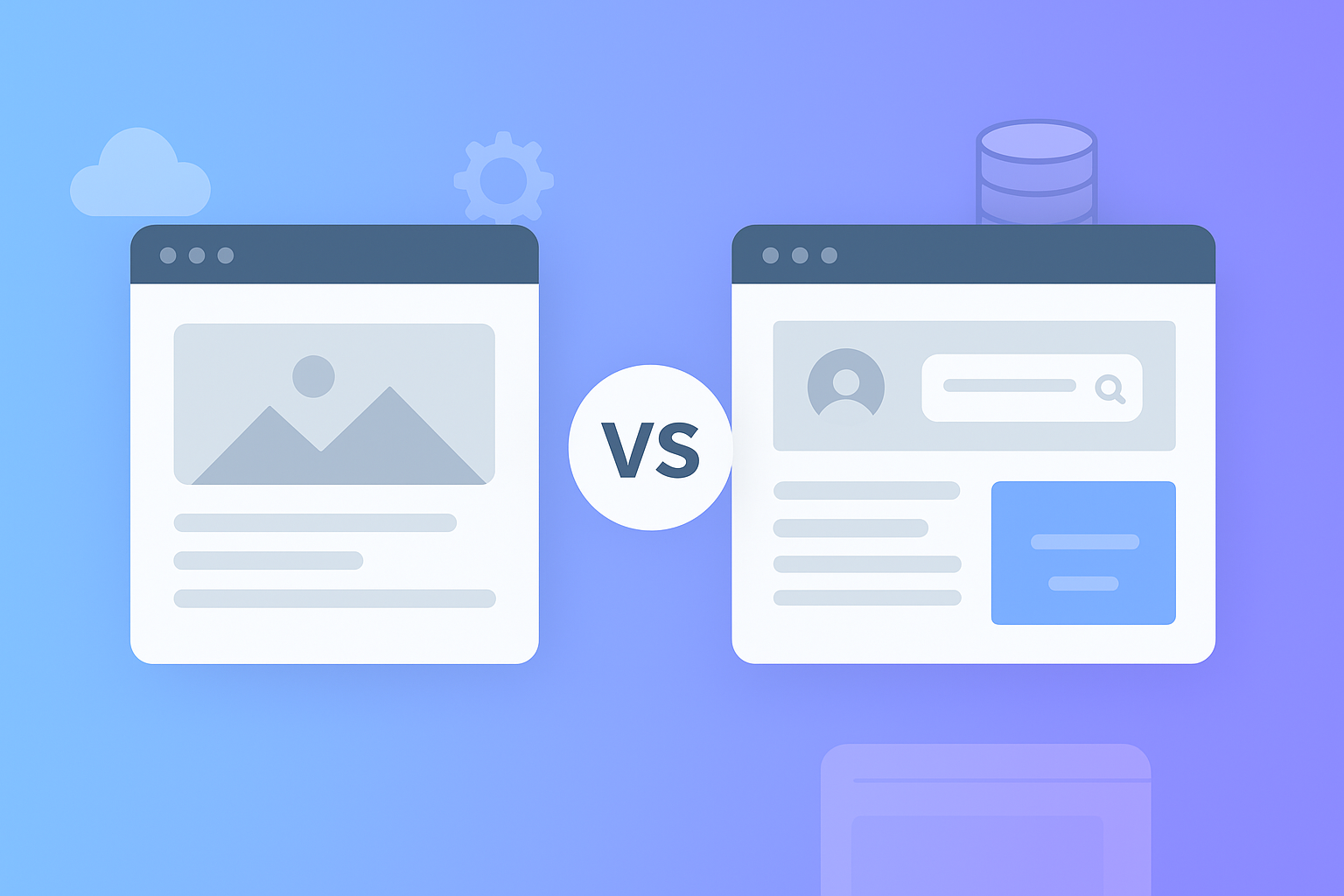
Static vs. Dynamic Websites: Here’s the Difference
In an era where businesses are increasingly relying on online presence, choosing the right type of website can make all the difference. Whether you’re partnering with a design and development company, understanding whether to build a static or dynamic site is key.
So let’s dive into the distinctions, advantages, disadvantages, and how you can tell the difference between a static and dynamic website.
What is a static website?
A static website is one in which each page is pre-built as an HTML file (often with CSS and maybe JavaScript) and is delivered exactly the same way to every visitor. In essence, the server simply serves up existing files without generating content on the fly. These sites are commonly used for basic business brochures, portfolios, and informational pages, where the content doesn’t change frequently and interactivity is minimal.Static Website Example
Imagine a small local café hiring a website design and development service. The site includes Home, About Us, Menu, and Contact pages; each built using static HTML/CSS. If the menu is updated only occasionally and no user accounts or dynamic features are required, this qualifies as a static website.Static Website Advantages
- Speed: Static pages load faster as they don't need server-side processing or database queries. For example, research shows that websites loading within 2 seconds have a 47% higher conversion rate.
- Simplicity and cost-effectiveness: With fewer moving parts and no database, hosting and maintenance costs are generally lower.
- Security: With no server-side logic or database to exploit, the attack surface is smaller.
- Reliability and scalability (to an extent): Since static files can be served via a CDN, the site can handle traffic surges with minimal backend load.
Static Website Disadvantages
- Limited interactivity or dynamic content: Because everything is built ahead of time, it’s challenging to include features like user accounts, customized content, or frequent updates without extra tooling.
- Content updates can be tedious: If you need to update many pages or change global elements (e.g., the footer), you may have to edit multiple files unless you use a static site
- Not ideal for large or frequently changing websites: If your business (or your design and development company) anticipates frequent content changes, user engagement, or sophisticated features, static may not suffice.
What is a dynamic website?
A dynamic website generates content on the fly. When a user requests a page, the server runs code using languages like PHP, Python, or Ruby, retrieves data from databases, and constructs the HTML tailored to the user or context. Dynamic websites allow for interactive, personalized, and frequently updated content, making them ideal for e-commerce, portals, and websites with user accounts or content management systems.Dynamic Website Example
Suppose a retail brand hires a website design and development service. They build an e-commerce platform where users log in, view past orders, get personalized recommendations, search a product catalog, have a shopping cart, etc. This is a dynamic website: pages are generated in real time and change based on user input and data.Dynamic Website Advantages
- Flexibility and interactivity: You can have user log-ins, personalization, dynamic content feeds, search, filters, user dashboards, etc.
- Efficient content management: With a CMS or database backend, you can update content without manually editing individual pages. This makes scaling easier when using comprehensive website design and development services.
- Better suited for growth: As your business expands, the dynamic framework supports adding new features and adapting rapidly.
Dynamic Website Disadvantages
- More complex and expensive to build and maintain: Because there are more layers (databases, server-side logic, backend frameworks), the cost and time are higher.
- Potentially slower performance: Because each request may trigger server processing, dynamic sites can have higher latency unless optimized.
- More security vulnerabilities: With databases and server-side code comes a higher chance of exploits, requiring more rigorous safeguards.
- Greater maintenance effort: Updates to code, database migrations, and backend dependencies require consistent attention and resources.
How to Tell the Difference Between a Static and Dynamic Website
When assessing whether a website is static or dynamic (or which type your business should choose when engaging a design and development company), here are some pointers:- URL and content variation: Does the same URL always show the same content, or does it change based on user (e.g., ?id=123 or /user/profile)? Dynamic pages often have query parameters or reflect user data.
- Interactivity and personalized features: If there are features like user login, dashboards, live data updates, search, or forms that feed into a database, the site is likely dynamic.
- How changes are made: If the client updates content through a backend CMS and it shows up instantly everywhere, that suggests dynamic. If every page must be edited manually, that suggests static.
- Page generation behavior: With static, the page you request is likely pre-built; with dynamic, server-side code runs to build the page on request.
- Speed and performance clues: Very fast loading and minimal backend processing may hint at static; longer load times or noticeable server processing may suggest dynamic. Keep in mind the difference can be subtle.
- Ask your design firm: If you are working with a website design and development service, ask them whether your site will be static or dynamic, and the implications for updates, scalability, and cost.
Understanding Static and Dynamic Websites
In practice, many modern websites adopt a hybrid model—certain pages may be static (like the “About Us” or “Terms” pages) for speed and simplicity, while others are dynamic (like user dashboards, blogs, or e-commerce sections) to support flexibility. According to Contentful, “static and dynamic refer to how the page is initially delivered from the server to the user’s browser” rather than how interactive it is. For companies offering website design and development services, it’s important to evaluate your business goals:- If your website is a digital brochure for a small business with limited updates, employing a static architecture may be sufficient, cost-effective, and efficient.
- If you anticipate frequent content changes, personalization, user interaction, growth, or e-commerce, then a dynamic website built by a full-service design and development company is likely the better route.
